I like to steal pieces of other languages. I’m not fluent in anything besides English. I study a language for a little bit, learn little factoids, then jump to the next.
However, I am proficient in two languages: Middle English and Chinuk Wawa. Middle English, Chaucer’s languages, has been part of me since I was 16. I studied Chinuk Wawa for two years through the online program at Lane Community College, and continue to practice it.
Among the other languages I’ve collected is Hindi. I know………………..not much, but I do watch Bollywood movies regularly, so I can do small talk. I also taught myself devanagari, the writing system used in Hindi and other Indic languages. I’m very slow reading it, but I can.
However, I swore after that, no more learning new writing systems. My brain is full. I really wanted to learn Cyrillic, but my brain said, nope, the letter storage system is full.
Chinuk Wawa is the southern dialect of a trade language, based around the Confederated Tribes of Grand Ronde; the northern dialect, based around Vancouver, BC, is called Chinook Jargon. Historically it was referred to as “The Jargon.”
While the vocab is a mix of indigenous languages like Chinook and Nootka, the writing system is the Latin alphabet. As Grand Ronde continues their revitalization work, they have added some additional characters (barred L, ł; the schwa, ə); my brain has kindly allowed me to learn these letters.
In Vancouver, however, the Jargon did develop a writing system, based on Duployan Shorthand, a French shorthand. This written form is commonly called Chinook Pipa or Kamloops Wawa (after a newspaper of the same name).
Because it wasn’t used in the south, which is version I learned, and because it’s a completely different fucking writing system, I ignored it. I have Latin, and devanagari, and thorns, eths, yoghs, barred Ls, and schwas. I’m good.
But last year, I attended the Chinook Jargon gathering in BC, and I will attend again this year. All the Canadians can read Chinook Pipa. As an American, I already look foolish enough.
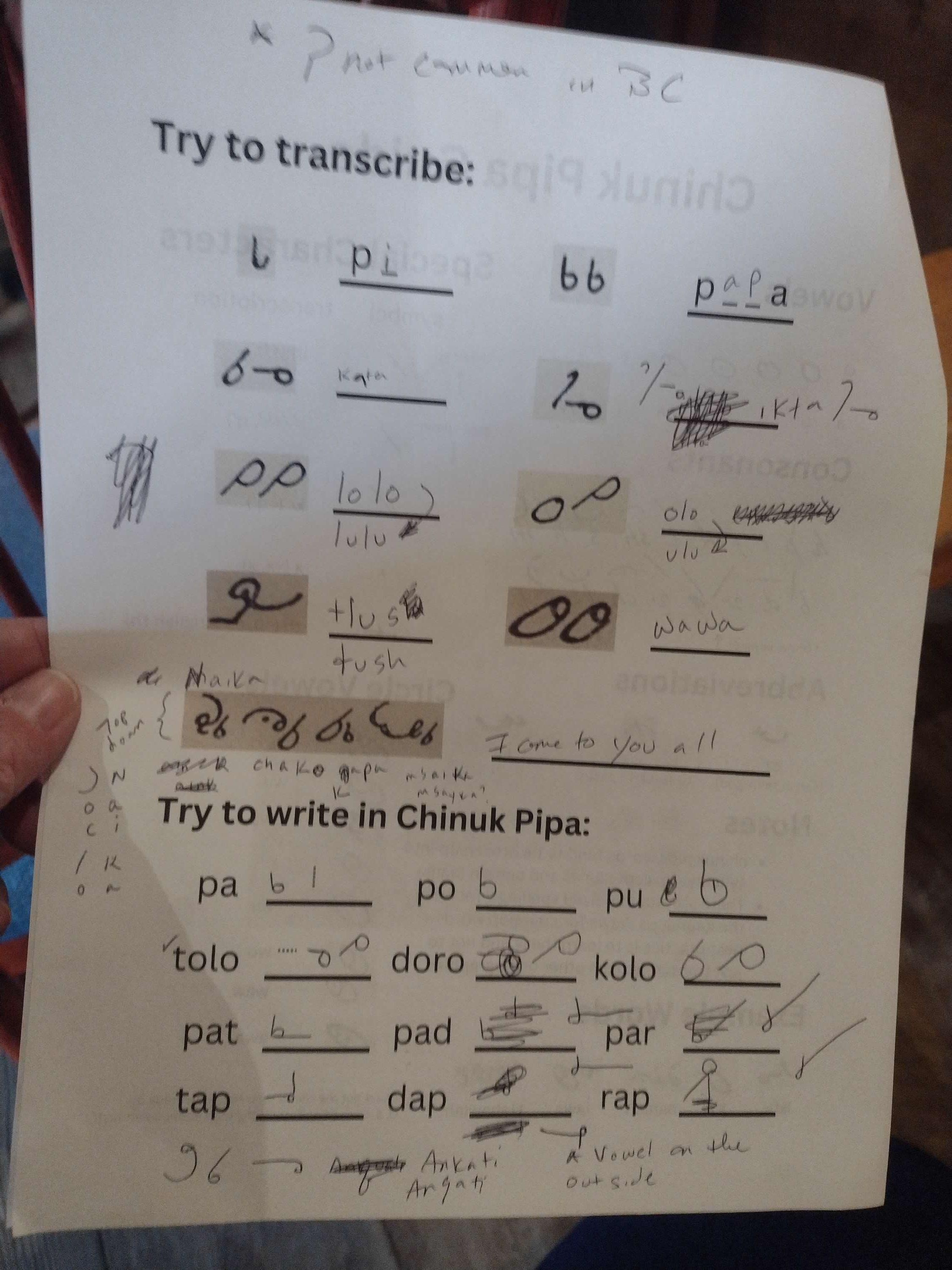
Soooooo I’m learning Chinook fucking Pipa. I’m starting with Chinook Rudiments and after that, I ‘unno, whatever Kaltash Wawa suggests.
But what is a fun adventure is how much deciphering Pipa is like reading Middle English. Chaucer was writing in London in the late 1300s, not long before the language becomes standardized. It’s pretty easy. But older Middle English, or ME from other parts of England, can be much harder to understand. And since the language wasn’t standardized, people could write a word in a multitude of ways. It can be a real puzzle to figure out what word is being used.
With Pipa, first I have to translate it into the Latin alphabet, then translate it from Northern to Southern dialect (and maybe from historic to modern usage).
łush is a good example. sorry for the pun.
“łush” means “good.” The barred L is pronounced like an L that’s an SH or vice-versa. (Devanagari has a d pronounced like an r, it’s all a weird circle.)
In the Northern Dialect, the word is kloosh (you might also see klush or tloosh), which is traditionally how that sound was represented in writing, in both the north and the south.
In Pipa, it’s written as tloos. Like that’s not a huge jump to modern Jargon, but still. So many layers to pull apart.
Still, at the moment my notebook has a ton of Pipa that I need to look up and piece together what the word is in the Southern Dialect. Just so the Canadians won’t laugh at me.
kHEpit kakwa.

Leave a Reply